
Awaab's Law
1. Introduction
1. Introduction
Awaab’s Law will come into force for the social rented sector from 27 October 2025. From this point social landlords will have to address all emergency hazards and all damp and mould hazards that present a significant risk of harm to tenants to fixed timeframes.
In 2026 we will extend regulations to include the following hazards where they present a significant risk of harm:
- excess cold and excess heat
- falls associated with baths etc., on level surfaces, on stairs and between levels
- structural collapse, and explosions
- fire, and electrical hazards
- domestic and personal hygiene and food safety
In 2027, we will extend regulations to all remaining HHSRS hazards (apart from overcrowding) where they present a significant risk of harm.
Social landlords should ensure they are preparing for the future expansion of Awaab’s Law. This guidance includes information in relation to damp and mould hazards that will be in scope for the first phase of Awaab’s Law and will be updated to include other hazards ahead of the coming into force of further phases. We want to make sure that this policy works effectively through taking a ‘test and learn’ approach and will implement any lessons learned between phases.
The phased approach does not mean that social landlords have leeway on addressing dangerous issues in their homes in the meantime. Social landlords should continue to meet their legal duties to keep homes safe by fixing disrepair, and keeping their homes fit for human habitation and free of dangerous ‘category 1’ health or safety hazards. They should continue to meet the outcomes set out by the Regulator of Social Housing in its Safety and Quality standard.
1.1. Context
The Regulations are also known as ‘Awaab’s Law’ in memory of two-year old Awaab Ishak, who died tragically in 2020 as a result of a severe respiratory condition due to prolonged exposure to mould in his home. Awaab’s parents had complained repeatedly to their social landlord in the three years prior to Awaab’s death, but no action was taken by their social landlord to treat the mould.
Living in hazardous conditions can have a substantial impact on people’s health, safety and wellbeing. While many landlords take timely and effective action to address hazards, Awaab’s Law serves as a legal backstop for the cases where social landlords are failing to make repairs quickly enough and leaving their tenants at risk.
The primary legislation for Awaab’s Law was first introduced through the Social Housing (Regulation) Act 2023, and inserts (or in legal terms ‘implies’) into social housing tenancy agreements a term that requires social landlords to comply with the requirements that are set out in these Regulations. This means all social landlords have to meet the requirements in the Hazards in Social Housing (Prescribed Requirements) (England) Regulations 2025, and if they do not, named tenants can hold their social landlords to account by taking legal action through the courts for a breach of contract. Other avenues of redress are available to tenants via the social landlord complaints procedure and the Housing Ombudsman Service.
A summary of the Regulations can be found in section 13.1.
1.2. Who is this guidance for?
This guidance refers specifically to Awaab’s Law in the social rented sector. Registered providers of social housing (referred to in this guidance as social landlords), should follow this guidance to support compliance with the requirements under Awaab’s Law. Registered providers are social landlords registered with the Regulator of Social Housing. They may be local authorities or private registered providers of social housing (such as a housing association).
We will publish guidance for tenants before the regulations come into force on 27 October 2025.
1.3. How to use this guidance
This document has been produced to help social landlords navigate their responsibilities in relation to Awaab’s Law. This guidance is not an authoritative interpretation of the law but intended as a general guide. This guidance provides examples of how Awaab’s Law may apply in particular cases. The application of Awaab’s Law will be fact specific and therefore social landlords will need to make their own judgement as to what Awaab’s Law may require in any particular case. Social landlords will be required to apply judgment where necessary and should create internal policies with the right governance and oversight to ensure they are applied and fit for purpose, in order to ensure consistent application of Awaab’s Law.
The guidance is structured to provide detail on the requirements under each regulation relating to Awaab’s Law, followed by information on enforcement. A summary of the Regulations can be found in section 13.1. To distinguish between guidance on legal obligations under Awaab’s Law and on best practice, the guidance will use the terms ‘must’ and ‘should’ respectively. ‘Must’ means a requirement of the regulations, ‘should’ means good practice that will support compliance, and ‘may’ means best practice actions we would encourage landlords to do where possible.
The document uses specific terminology: to aid with interpretation of the guidance, a list of references can be found in section 13.2.
The Regulations and this guidance should be considered alongside other relevant legislation and guidance relating to health and safety and repairs in social homes. More information on this can be found in section 12.
Landlords should take independent legal advice if they are unclear about their obligations under Awaab’s Law or other relevant legislation.
1.4. Awaab’s Law requirements on social landlords
The Regulations mean landlords must:
- investigate any potential emergency hazards and, if the investigation confirms emergency hazards, undertake relevant safety work as soon as reasonably practicable, both within 24 hours of becoming aware of them
- investigate any potential significant hazards within 10 working days of becoming aware of them
- produce a written summary of investigation findings and provide this to the named tenant within 3 working days of the conclusion of the investigation
- undertake relevant safety work within 5 working days of the investigation concluding, if the investigation identifies a significant hazard
- begin, or take steps to begin, any further required works within 5 working days of the investigation concluding, if the investigation identifies a significant or emergency hazard. If steps cannot be taken to begin work in 5 working days this must be done as soon as possible, and work must be physically started within 12 weeks
- satisfactorily complete works within a reasonable time period
- secure the provision of suitable alternative accommodation for the household, at the social landlord’s expense, if relevant safety work cannot be completed within specified timeframes
- keep the named tenant updated throughout the process and provide information on how to keep safe
Upon becoming aware of a potential hazard, social landlords should use all available information to initially determine if the hazard is a potential significant or emergency hazard and take steps to complete relevant safety work within stated timeframes.
Under Awaab’s Law, social landlords have a defence if they have taken all reasonable steps to comply with the requirements but have been unable to comply for reasons beyond their control (Section 10A(5) of the Landlord and Tenant Act 1985). For more on this defence see section 9.
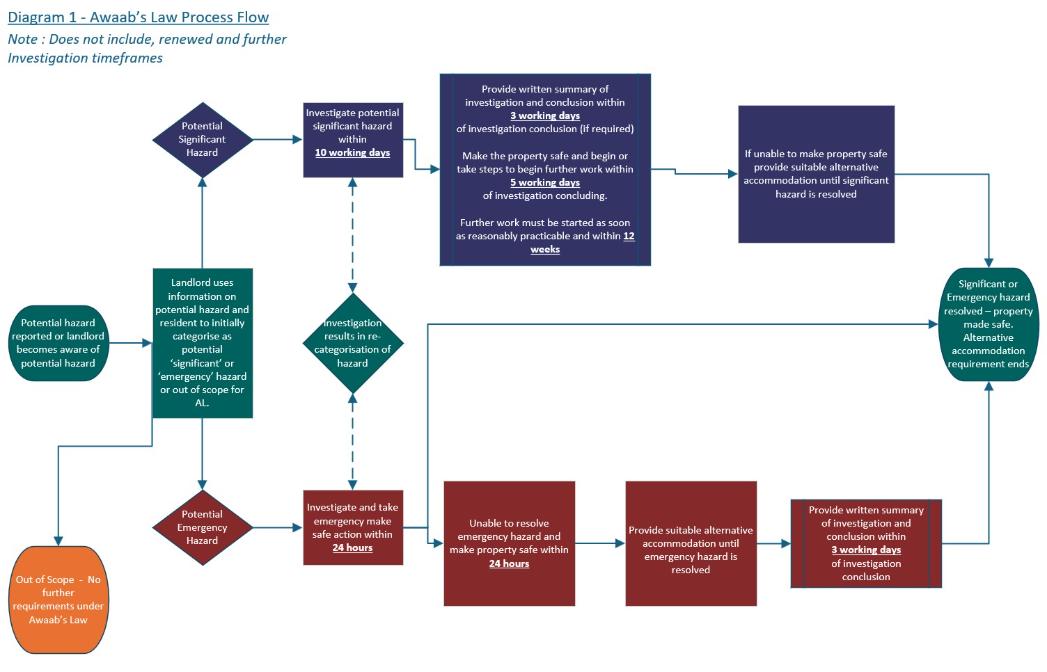
Diagram 1 provides a simplified overview of the process and timeframes under Awaab’s Law for addressing significant or emergency hazards. It does not include renewed and further investigations. For full details, please refer to the relevant sections of the guidance.
Route one: Where the social landlord believes there is a significant hazard
Step 1:
A potential hazard is reported or the landlord becomes aware of a potential hazard. The social landlord reviews available information about the hazard and the resident’s circumstances. Based on this, they make an initial assessment to decide whether the issue is a potential ‘significant’ or ‘emergency’ hazard, or if it falls outside the scope of Awaab’s Law. This is Day Zero in the Awaab’s Law timeline.
Step 2:
If a potential significant hazard is identified, the landlord must carry out an investigation within 10 working days. If the investigation confirms an emergency hazard the landlord should follow the process for emergency hazards, for the purpose of this diagram this is route two.
Step 3:
If the landlord’s investigation (completed within 10 working days) confirms a significant hazard, they must:
- provide a written summary of the investigation and its findings to the resident within 3 working days of the conclusion
- complete relevant safety works and begin or take steps to begin any further supplementary works to prevent the hazard from reoccurring within 5 working days of concluding the investigation
- where further supplementary works are required and it is not possible to begin them within 5 working days, the landlord must start these as soon as reasonably practicable and within 12 weeks of the investigating concluding
If the investigation finds an emergency hazard the landlord should follow the process for emergency hazards, for the purpose of this diagram this is route two.
Step 4:
If the property cannot be made safe, the landlord must offer suitable alternative accommodation until the significant hazard is fully resolved.
Step 5:
The significant hazard is resolved, all required safety works are completed, and the obligation to provide alternative accommodation under Awaab’s Law ends.
Route 2: Where the social landlord believes there is an emergency hazard
Step 1:
A potential hazard is reported or the landlord becomes aware of a potential hazard. The social landlord reviews available information about the hazard and the resident’s circumstances. Based on this, they make an initial assessment to decide whether the issue is a potential ‘significant’ or ‘emergency’ hazard, or if it falls outside the scope of Awaab’s Law. This marks day zero in the Awaab’s Law timeline.
Step 2:
A potential emergency hazard is identified. The landlord must investigate the issue within 24 hours.
Step 3:
If the landlord’s emergency investigation confirms an emergency hazard, they must:
- complete all relevant safety works and make the property safe within 24 hours
- if the property cannot be made safe within 24 hours, the landlord must offer suitable alternative accommodation until the required safety works are completed
- provide a written summary of the investigation and its findings within 3 working days of the conclusion (if required)
Step 4:
The emergency hazard is resolved, all required safety works are completed, and the obligation to provide alternative accommodation under Awaab’s Law ends
Route 3: Where the social landlord believes the issue is out of scope of Awaab’s Law
Step 1:
A potential hazard is reported or the landlord becomes aware of a potential hazard. The landlord reviews the information about the potential hazard and the resident’s circumstances, and determines that the issue is outside the scope of Awaab’s Law.
1.6 Housing Health and Safety Rating System (HHSRS)
Awaab’s Law applies to the types of hazards prescribed by the HHSRS (other than overcrowding), but does not require a full HHSRS assessment.
Instead, Awaab’s Law uses a person-centred approach: a more straightforward assessment should be made which considers the tenant’s circumstances when assessing the risks presented by a hazard. Awaab’s Law therefore does not require a hazard to be at category 1 level under HHSRS in order to be in scope as there may be instances where a particular tenant is at a greater risk from hazardous conditions. For example, a tenant with age or health related vulnerabilities may be at significant risk from a home affected by damp and mould, even if it were scored as a category 2 hazard under the HHSRS.
The enforcement of Awaab’s Law is also different to the HHSRS. Where a hazard in scope of Awaab’s Law is also subject to local council enforcement, social landlords must comply with whichever timeframe for repairs is the shorter.
1.7 Which type of housing does Awaab’s Law apply to?
Awaab’s Law applies to almost all social housing occupied under a tenancy and let by a registered provider. The exception is for social housing occupied under a tenancy which is excepted from the repairing obligation in section 11 of the Landlord and Tenant Act 1985 by section 14 of that Act.
Awaab’s Law applies to temporary and supported accommodation occupied under a tenancy, that is social housing let by a registered provider. Awaab’s Law does not apply to temporary accommodation, supported accommodation, or other housing occupied under a licence.
Awaab’s Law does not apply to long leaseholds or other owner-occupied accommodation and low-cost home ownership homes, including shared ownership.
Reference Notice): This content includes information derived from HM Government’s official publication Awaab’s Law: Draft Guidance for Social Landlords (2024), available on Awaab’s Law: Draft guidance for social landlords The material has been referenced to ensure accuracy and alignment with current UK Government guidance regarding landlords’ responsibilities for addressing damp and mould hazards in residential properties.