
Awaab's Law

4. Investigating whether there is a significant or emergency hazard
If a social landlord has reason to believe a home is affected by a significant hazard, (see section 3.2) they must investigate the hazard within 10 working days. If they suspect it is an emergency hazard, different timeframes apply (see section 3.3 and section 4.1.3.
The social landlord must ensure an investigation is conducted by a person who (in the reasonable opinion of the social landlord) is competent to do so. This should be a person with the skills and experience necessary to determine whether the social home is affected by a significant or emergency hazard. A social landlord should use properly qualified specialists to investigate where relevant.
4.1 Types of investigations
Under Awaab’s Law there are 4 key types of investigations.
- Standard investigations
- Renewed investigations
- Further investigations
- Emergency investigations
4.1.1 Standard investigations
Landlords should conduct a standard investigation within 10 working days of becoming aware of a potential hazard. This must confirm whether or not there is a significant or emergency hazard and must also, if possible, identify the required work to make a property safe and prevent the hazard from recurring. For the purposes of the regulations, day one of the 10-day timeline is the day after the landlord becomes aware of the potential hazard.
Standard investigations can be conducted remotely unless the named tenant specifically requests an in-person investigation. For example, if evidence such as photos or videos that sufficiently enable the person investigating on behalf of the social landlord to determine whether there is a significant or emergency hazard is provided it may be possible to conduct the investigation remotely. The findings of previous investigations, under Awaab’s Law or otherwise, can be taken into account by the investigation.
If a tenant later reports a material change relating to the hazard, or the social landlord becomes aware of a material change through other routes it must investigate again to the same timeframes. A material change could include a change to the severity of the hazard or a change to the effect it is having on the tenant’s health. For example, if a tenant reports new symptoms or worsening symptoms that may be associated with the hazard, or if they report that the hazard has worsened since the time of investigating. Where there has been a material change a new “standard investigation” is required under the regulations, and timeframes under Awaab’s Law start again.
Under Awaab’s Law regulations, social landlords are protected from repeated and unfounded vexatious claims as they will only be required to investigate where there has been a material change to a matter of which they are already aware. This means that social landlords will not be in breach of Awaab’s Law if they fail to respond within timeframes to an issue that they have already investigated, unless they become aware that circumstances have changed.
If during a standard investigation the social landlord has reasonable grounds to believe there is an emergency hazard, then they must complete the investigation as an emergency investigation, in line with emergency investigation timeframes. Emergency timeframes will start from the point at which the potential for an emergency hazard is uncovered (see section 3.3).
4.1.2 Renewed investigations
If a named tenant specifically requests an in-person inspection after an investigation has been done remotely, a ‘renewed’ in-person investigation must be carried out. For potential significant hazards, social landlords must complete the renewed investigation within 10 working days of the request, so the timeline for investigation is effectively reset. This must confirm whether or not there is a significant or emergency hazard and must also, if possible, identify the required work to make a property safe and prevent the hazard from recurring. Tenants should therefore be encouraged to request an in-person inspection in the first instance, if they believe one is required. For potential emergency hazards, the tenant may request an in-person investigation within 10 working days if an initial remote investigation concludes there is not an emergency hazard or if the initial investigation finds an emergency hazard but does not identify any relevant safety work to address the emergency hazard.
Under Awaab’s Law, landlords are not required to undertake a renewed investigation if required works to prevent the hazard from recurring have already begun, if relevant safety work under regulation 5 (emergency action), or a further investigation (under regulation 8) is required. However in a case where a further investigation is required a landlord is required to conduct an in-person inspection under the provision relating to further investigations, if the tenant so requests.
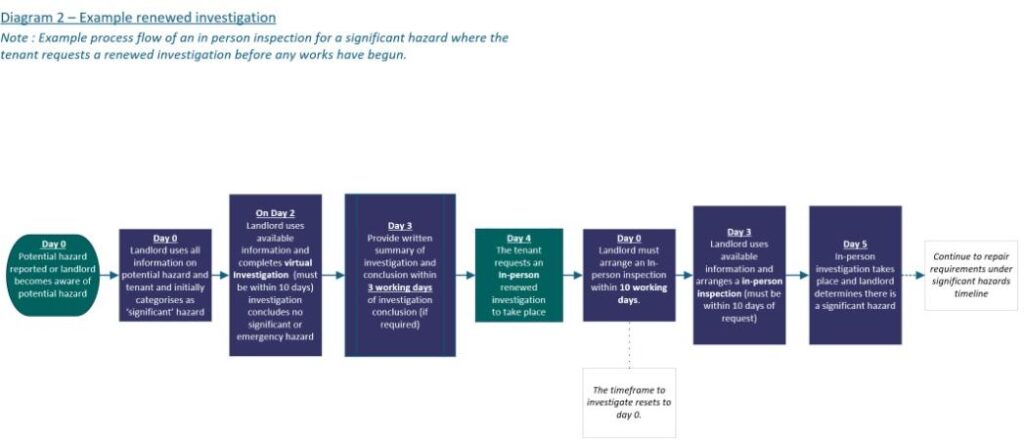
Hypothetical Scenario: Renewed Investigation Process
This example illustrates a simplified timeline for a renewed investigation under Awaab’s Law. It provides an example of an in person inspection for a significant hazard where the tenant requests a renewed investigation before any works have begun. It is intended for general understanding only and does not cover all possible circumstances.
Day Zero:
A potential hazard is reported, or the landlord becomes aware of one.
The landlord reviews the information and initially categorises it as a potential significant hazard.
This is Day 0 under Awaab’s Law timeframes.
Day Two:
The landlord completes a virtual investigation using available information (within the required 10 working days).
The investigation concludes that there is no significant or emergency hazard under Awaab’s Law.
Day Three:
The landlord provides a written summary of the investigation and its conclusion, within 3 working days of completing the investigation.
Day Four:
The tenant requests a renewed in-person investigation.
At this point, the Awaab’s Law timeframes reset to Day 0.
Day Zero (Reset):
Following the tenant’s request, the landlord must arrange an in-person inspection within 10 working days.
Day Three (Reset):
The landlord uses available information and arranges the in-person inspection.
Day Five (Reset):
The in-person investigation takes place, and the landlord determines that there is a significant hazard
Continue to repair requirements under significant hazards timeline
4.1.3 Emergency investigations
Emergency investigations are required if social landlords have reasonable grounds to believe that there is an emergency hazard affecting the social home. The investigation must confirm whether or not there is a significant or emergency hazard and must also, if possible, identify the required work to make a property safe and prevent the hazard from recurring. In these circumstances the social landlord must investigate within 24 hours of social landlords forming that belief. Emergency investigations can be done remotely.
If, during a standard or renewed investigation, the landlord comes to believe that there may be an emergency hazard, the emergency action requirements begin to apply, and the investigation must be completed as an emergency investigation within 24 hours of the completion of the investigation that identified the emergency hazard.
4.1.4 Further investigations
There may be circumstances where the standard, emergency or renewed investigation is unable to determine the extent of, or underlying cause of, a significant or emergency hazard. In this circumstance a further investigation must be completed as soon as reasonably practicable to determine what work is required to make the property safe and prevent the hazard from reoccurring. For example, if a property is affected by a damp and mould hazard, the standard investigation may conclude that a structural survey is needed to diagnose the underlying cause of damp. The landlord is still required to undertake relevant safety work while further investigations are underway, such as providing a dehumidifier and specialist mould wash.
The further investigation must include an in-person inspection if the tenant so requests it (and an in-person inspection has not already been carried out).
If an investigation has identified relevant safety work, the social landlord must complete the relevant safety work within 5 working days of the investigation that concludes there is a significant hazard or 24 hours of an investigation that concludes there is an emergency hazard, even if a further investigation is pending. (See section 3.2 and 3.3.)
4.2 Access
Landlords should seek to obtain access to the property to investigate and/or complete relevant safety works as quickly as possible, and it is recommended that they keep clear records of their attempts.
Reasonable steps to gain access could include:
- working with the tenant to arrange a suitable time to visit the property, offering a range of timeslots and considering the tenants’ needs (e.g. their working pattern)
- making multiple attempts at various times of the day to contact tenants and using different routes if one fails (e.g. phone calls, emails or letters)
- making best efforts to engage with tenants and provide information on why access is needed and what they can expect, in a way that meets their needs (e.g. providing translation services and accessible communications, or information about who will be attending to provide reassurance)
- taking into account any issues or barriers to allowing access and working with the tenant to overcome them
- if the social landlord is unable to access the property within the agreed timeslot, leaving the tenant a notice stating that an attempt was made and providing contact details to arrange an alternative slot
Gaining access to a property may be a barrier to investigating or carrying out required safety works. If a tenant is unwilling or unable to provide access to the registered provider within the timeframes, social landlords should not be found in breach for missing the timeframes if they can show they have taken all reasonable steps to comply.
It would ultimately be for the court to decide if the social landlord had used all reasonable steps depending on the individual circumstances.
The landlord and tenant should work together to agree on a suitable time for access to the property. Tenants are expected to actively engage with the landlord to arrange a convenient appointment, while landlords should clearly communicate that any delays in gaining access may lead to delays in completing the necessary safety work.
Scenario: Landlord gaining access to investigate
The tenant reported damp and mould in multiple areas of the property. The landlord requested photos of the issue to allow a remote investigation so they could then arrange an appointment for a contractor to attend within 10 working days. However, the tenant was not available at the allocated time and the contractor was unable to gain access. A further appointment was scheduled for the following day, working in collaboration with the tenant to find a mutually convenient time.
In the scenario described, the landlord encountered difficulties in gaining access to the property to carry out the relevant safety work. When arranging the initial appointment, the landlord could have taken additional steps to ensure the timing was suitable for the tenant. This could have included following up through a phone call, text, or email to confirm the appointment, and offering a selection of time slots, including evenings or weekends, to better accommodate the tenant’s availability.
If the contractor was unable to gain access, they could have left a clear note at the property with contact details and instructions for rescheduling the visit at a mutually convenient time. In cases involving vulnerable tenants, it may also have been appropriate to liaise with a support worker, family member, or advocate to help coordinate access. Throughout the process, maintaining clear and consistent communication, and documenting all attempts to engage with the tenant, would demonstrate that reasonable efforts were made to comply with Awaab’s law regulations and ensure the tenant’s safety.
Reference Notice): This content includes information derived from HM Government’s official publication Awaab’s Law: Draft Guidance for Social Landlords (2024), available on Awaab’s Law: Draft guidance for social landlords The material has been referenced to ensure accuracy and alignment with current UK Government guidance regarding landlords’ responsibilities for addressing damp and mould hazards in residential properties.